TIP® Program
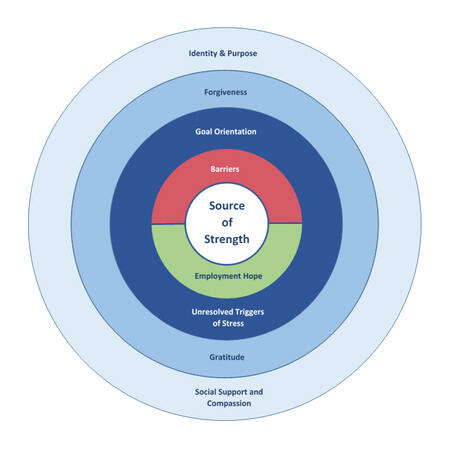
TIP® program was developed by Dr. Philip Hong and his research team at Loyola University Chicago and at University of Georgia. It is a transformative social change model that serves as a framework to empower individuals and to have lasting ripple effects on the outer layers of social systems for greater impact. Based on 21 years (2004-2025) of evidence generated through Dr. Hong’s research on psychological self-sufficiency (PSS) in workforce development, TIP emerged as a core job readiness content that supports successful employment and economic outcomes in the labor market.
Starting in the summer of 2014, Dr. Hong and his research team in collaboration with Hope Works, a social service agency in Woodlawn, Chicago, partnered in developing TIP and implemented its first training at Hope Works in November 2014. TIP has received strong support and has been used by the Mentoring Program at Safer Foundation. TIP as an evidence-informed program will challenge the workforce system and labor market in general to be more human-centered.

What is TIP®?
1.
Evidence-informed intervention model that addresses the psychological self-sufficiency (PSS) process in workforce development.
2.
PSS comprises perceived employment barriers and employment hope. They can be measured by the Perceived Employment Barrier Scale (PEBS) and the Short Employment Hope Scale (EHS-14) (see Research for related publications).
3.
PSS is conceptualized as a psychological capital that serves as the core skill set necessary to develop and glue together the mosaic of all human and social capital.
4.
TIP® program is an evidence-informed intervention model developed by research team at Loyola University Chicago in collaboration with group work practitioners. Its transformative leadership development curriculum empowers the participants to develop self-awareness, confidence, hope, goal-orientation, leadership, accountability, conscientiousness, and grit, it is anticipated that it improves both employment and retention outcomes. TIP program is made up of transformative 15-session employment readiness modules designed to assist low-income job seekers transition from long-term unemployment—due to welfare receipt, homelessness, substance abuse, mental health issues, prison sentencing, etc.—to employment.
TIP® Application
Workforce development
Health and mental health
Housing / homelessness
Youth development / academic success
Ex-offender reentry
Social enterprise
Financial literacy and capability
Refugee resettlement
Native American empowerment
TIP® Curriculum Outline I
| Weeks | Themes | Topics |
|---|---|---|
| 1 | Evaluation | PSS Survey I |
| 2 | Identity & Purpose | TIP 1: Who am I? / Purpose in Life |
| 3 | Forgiveness | TIP 2: Self-Compassion |
| 4 | Goal-Orientation I | TIP 3: Goal Setting |
| 5 | Goal-Orientation II | TIP 4: Improvement & Pathways I |
| 6 | Barriers | TIP 5: Barrier Inventory |
TIP® Curriculum Outline II
| Weeks | Themes | Topics |
|---|---|---|
| 7 | Source of Strength | TIP 6: My strength comes from ... |
| 8 | Evaluation | PSS Survey II |
| 9 | Employment Hope I | TIP 7: Love / Self-Worth |
| 10 | Employment Hope II | TIP 8: Self-Perceived Capability |
| 11 | Employment Hope III | TIP 9: Future and the Possibilities |
| 12 | Employment Hope IV | TIP 10: Self-Motivation |
TIP® Curriculum Outline III
| Weeks | Themes | Topics |
|---|---|---|
| 13 | Employment Hope V | TIP 11: Skills and Resources Inventory |
| 14 | Employment Hope VI | TIP 12: Renewed Goal Commitment / Improvement & Pathways II |
| 15 | Unresolved Triggers of Stress | TIP 13: Managing Stress & Anger |
| 16 | Gratitude | TIP 14: Finding Meaning in Life |
| 17 | Social Support and Compassion | TIP 15: Seeking Help & Helping Others |
| 18 | Evaluation | PSS Survey III |
TIP® Theory of Change